


The AI Revolution in Restoration
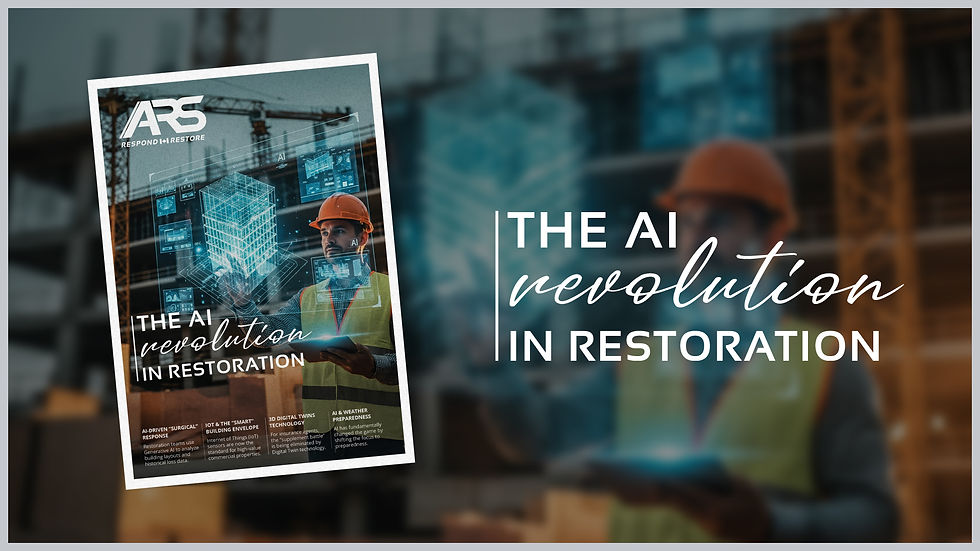
What You Will Learn in This Article
Using AI to analyze layouts so crews arrive with the exact equipment needed.
How IoT sensors stop minor leaks before they become million-dollar floods.
Reducing onsite visits and labour costs through remote moisture monitoring.
Eliminating "supplement battles" with millimeter-accurate 3D digital twins.
AI and Weather Preparedness
1. AI-Driven "Surgical" Response
Gone are the days of broad, destructive "rip and tear" investigations. In 2026, restoration teams use Generative AI and Predictive Analytics to analyze building layouts and historical loss data before even arriving on-site.
For Property Managers: This means crews arrive with the exact equipment needed for your specific building type, reducing the "setup" time that often delays recovery.
The Tech: AI route optimization now accounts for real-time Canadian traffic and weather patterns, shaving critical minutes off response times.
2. IoT and the "Smart" Building Envelope
With Canada’s extreme freeze-thaw cycles, "hidden" failures are a constant threat. Internet of Things (IoT) sensors are now the standard for high-value commercial properties.
Real-time Monitoring: Smart leak detection valves can now automatically shut off water supplies the second an anomaly is detected, turning a potential $1M flood into a minor $1,000 cleanup.
Remote Adjustments: Smart dehumidifiers allow technicians to monitor and adjust drying curves remotely. This reduces the number of onsite visits, lowering labour costs and minimizing disruption for your tenants.

3. 3D Digital Twins and Claims Transparency
For insurance agents, the "supplement battle" is being eliminated by Digital Twin technology (like Matterport and LiDAR).
Indisputable Documentation: Instead of hand sketches and photos, adjusters now receive a millimeter-accurate 3D walkthrough of the damage.
Faster Settlements: AI-powered "Claim Management Models" (CMMs) can audit these 3D scans against policy guidelines instantly, highlighting discrepancies and speeding up the approval of work orders by days or even weeks.
4. AI and Weather Preparedness
In the past, restoration was purely reactive. Today, AI has fundamentally changed the game by shifting the focus to preparedness. By integrating advanced AI-driven weather prediction models, we can anticipate extreme weather events with far greater precision before they hit. This foresight allows property managers to implement preventative measures—like staging equipment or securing building envelopes—significantly reducing the impact of a loss. For the industrial sector, this isn't just about weather tracking; it’s about strategic risk mitigation that protects the bottom line.

The Bottom Line for 2026
Technology hasn’t replaced the human touch in restoration; it has enhanced it. By leveraging AI, we increase accuracy, gain deeper insights, and better prepare for extreme weather events. For property managers, this ensures operational continuity; for insurance partners, it provides the data-backed transparency and streamlined processes that lead to happier clients.


Comments